
We make boring business stories sparkle.
Singapore Human Capital Guide for Foreign Investors: Salaries, Skills and Working Culture
A practical guide for foreign investors on Singapore's human capital market, salary expectations, talent strengths, language skills, education path and working culture.


A foreign founder lands in Singapore with a simple hiring plan.
She wants a country manager, two salespeople, one finance person, a software lead and a small support team. The office broker tells her Singapore is efficient. The bank says the company setup is straightforward. Then the first few salary expectations arrive, and the plan starts to look different.
The lesson is not that Singapore is too expensive. The lesson is that Singapore is not a low-cost labour market. It is a high-trust, highly educated, regional business hub. If you hire for the right roles, the premium can make sense. If you use Singapore for work that can be done just as well from a lower-cost market, the numbers may disappoint you.
This guide explains what foreign investors should expect from Singapore human capital: average pay, seniority, skills, language capability, education background, National Service obligations, working culture, and when it makes sense to hire locally versus in markets such as Malaysia, Vietnam or China.
The Short Answer
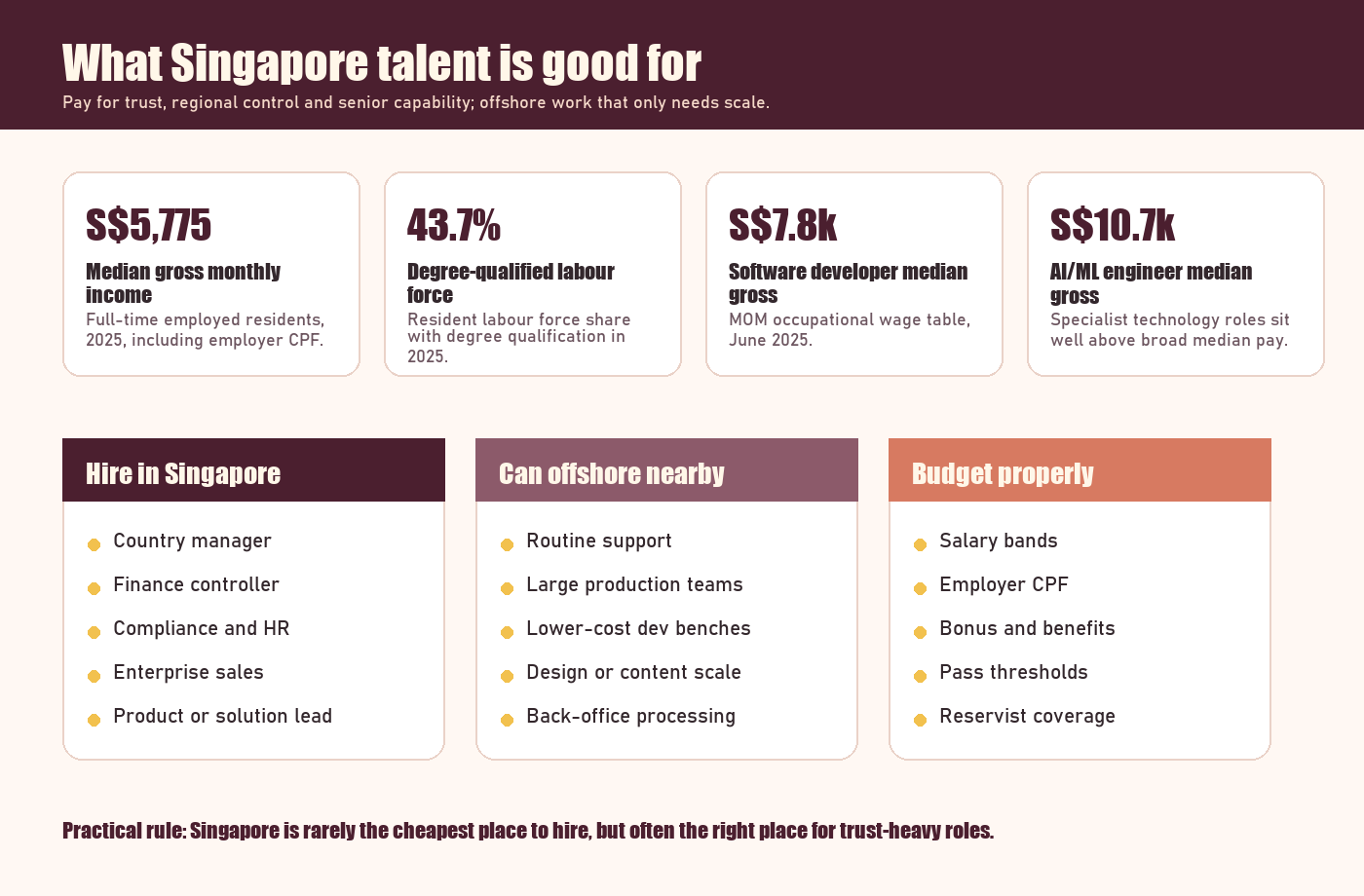
Singapore is best used as a control tower, commercial hub and senior-talent base, not as the cheapest place to build a large execution team.
Question | What to expect in Singapore | Investor takeaway |
|---|---|---|
Is talent cheap? | No. MOM’s 2025 median gross monthly income for full-time employed residents was S$5,775 including employer CPF. | Budget for premium wages, CPF, bonus and benefits. |
Is talent educated? | Yes. MOM’s 2025 labour force table shows 43.7% of the resident labour force with degree qualifications and 20.4% with diploma or professional qualifications. | Good for professional, technical, management and customer-facing roles. |
Is English common? | Yes. English is the working language for business, education and government interaction. | Good for regional HQ, investor-facing, customer-facing and documentation-heavy work. |
Are regional languages available? | Often, but uneven by language and role. Mandarin, Malay and Tamil exposure is common; Japanese, Korean, Thai, Vietnamese and European languages are more role-specific. | Hire deliberately if a language is mission-critical. |
Where does Singapore shine? | Finance, compliance, regional sales, logistics, product, cyber, data, operations management and enterprise customer success. | Use Singapore for trust-heavy and coordination-heavy roles. |
How Much Should You Expect to Pay?
There is no single average salary that works for planning. A foreign investor should think in bands: junior, experienced individual contributor, specialist, manager and regional leader.
The most useful official salary anchor is MOM’s occupational wage data. The figures below are from MOM’s June 2025 occupational wage tables for full-time resident employees, using median gross monthly wages unless otherwise stated.
Role type | Example occupation | Median gross monthly wage | What it suggests |
|---|---|---|---|
Broad resident workforce | Full-time employed residents | S$5,775 | Use this only as a general market anchor, not a hiring budget. |
Customer support | Customer service officer/clerk | S$3,300 | Lower than professional roles, but still not a low-cost offshore rate. |
Operations/admin | Operations officer (administrative) | S$4,160 | Good local process talent, especially when Singapore context matters. |
Accounting | Accountant, excluding tax accountant | S$5,968 | Finance talent is available, but experienced staff cost more. |
Sales | Sales manager | S$8,559 | Commercial roles can be expensive, especially with regional scope. |
Software | Software developer | S$7,808 | Singapore has tech talent, but competing employers push pay up. |
Specialist tech | AI/machine learning engineer | S$10,700 | Specialist roles should be budgeted as premium hires. |
Cybersecurity | Cyber risk specialist | S$10,495 | Security and risk talent is valuable and competitive. |
Senior architecture | Enterprise/solution/software architect | S$13,614 | Senior technical leadership can cost far above the broad median. |
Do Not Budget Only for Base Salary
For Singapore Citizens and Permanent Residents, employer CPF contributions can materially increase total employment cost. Many employers also budget for annual wage supplement or variable bonus, medical benefits, insurance, leave, payroll administration and learning budgets.
If you hire foreign employees in Singapore, work-pass rules matter too. MOM’s Employment Pass page shows current minimum qualifying salaries from S$5,600 for non-financial-services roles and S$6,200 for financial-services roles, increasing with age. From 1 January 2027, the stated minimums rise to S$6,000 and S$6,600 respectively. S Pass salary thresholds also increase progressively by age and sector.
For payroll-cost planning, connect this guide with SBO’s employer CPF contribution guide and mandatory payroll deductions guide.
Seniority and Experience: What the Market Feels Like
Singapore has a strong middle and senior professional market, but the small population means certain roles are competitive. A foreign investor should expect faster hiring for general professional roles and slower hiring for niche specialists.
Junior Talent
Junior hires may come from universities, polytechnics, ITE, private institutions or overseas universities. They can be strong, but may need structured onboarding, manager time and clear operating playbooks.
Junior talent works well when the company already has a senior person in Singapore or a regional lead who can coach them.
Experienced Individual Contributors
This is often the sweet spot for SMEs and foreign founders. These hires can run a function without needing the salary of a regional director.
Examples include accountants, HR executives, sales executives, customer success managers, operations coordinators, project managers, data analysts and software developers.
Senior and Specialist Talent
Senior Singapore hires can be valuable because they understand compliance, customers, documentation, regional nuance and stakeholder management. They also command a premium.
Roles such as finance controller, enterprise sales lead, compliance manager, cyber specialist, AI engineer, regional HR lead and solution architect should be budgeted carefully.
What Skills Are Readily Available?
Singapore’s talent pool is strongest where education, regulation, regional trade and multinational-company experience overlap.
Skill area | Availability | Notes for foreign investors |
|---|---|---|
Finance and accounting | Strong | Good for bookkeeping oversight, financial control, audit coordination, tax support and reporting. |
Compliance and governance | Strong | Useful for regulated industries, banking relationships, data protection and regional HQ controls. |
Sales and business development | Good but competitive | Enterprise sales, regional partnerships and channel roles can be expensive but valuable. |
Technology and product | Good but expensive | Software, data, AI, cyber and product roles exist, but high performers have many options. |
Operations and logistics | Strong | Singapore is strong in process, trade, logistics, procurement and service operations. |
Customer success | Good | Especially useful for B2B SaaS, fintech, professional services and regional account management. |
High-volume low-cost support | Limited fit | Consider Malaysia, Vietnam, the Philippines, India or China depending on language, quality and timezone needs. |
Language Skills: English First, Multilingual by Design
Singapore’s biggest language advantage is not just English fluency. It is the ability to operate across cultures.
English is the normal language for business communication, contracts, government interaction, education and corporate documentation. Many Singaporeans also have exposure to a mother tongue language, commonly Mandarin, Malay or Tamil, because of the education system and family background.
For foreign investors, this creates practical advantages:
- Regional staff can communicate with headquarters in English.
- Customer-facing staff can often handle multicultural Singapore buyers.
- Mandarin capability may help with China, Taiwan or Chinese-speaking customers, but business-level Mandarin should still be tested.
- Malay can be useful for Malaysia, Indonesia and Brunei context, though Bahasa Indonesia/Malay fluency varies by person.
- Japanese, Korean, Thai, Vietnamese and European-language skills exist, but should be hired as specific capabilities, not assumed.
If a language is critical to revenue, test it during hiring with actual customer scenarios instead of relying only on a resume line.
Education Path: How Singaporeans Usually Enter the Workforce
Singapore’s education system creates several routes into work. Foreign founders should not assume that only university graduates are useful.
A common path is primary school, secondary school, then one of several post-secondary routes:
- Junior college or pre-university: often leads to A-Level or equivalent routes before university.
- Polytechnic: diploma route with practical, applied training in areas such as business, engineering, IT, media, design and life sciences.
- Institute of Technical Education (ITE): technical and vocational route, including Nitec, Higher Nitec and work-study pathways.
- University: local, private or overseas degrees, often followed by internships, traineeships or professional qualifications.
- Continuing education: many workers upgrade through part-time degrees, professional certificates and SkillsFuture-supported training.
For employers, the practical point is simple: match the qualification route to the job. A polytechnic diploma holder with strong internship and technical experience may outperform a degree holder in an applied operations role. A degree may matter more for regulated, analytical or leadership-track work.
National Service and Reservist Duties
Male Singapore Citizens and many second-generation Permanent Residents generally serve full-time National Service before entering university or full-time work. This affects the talent pipeline in two ways.
First, many Singaporean men start university or full-time careers later than women or foreign peers because of full-time National Service. A male candidate may be slightly older than a non-NS peer at the same early-career stage.
Second, after full-time NS, many men remain liable for Operationally Ready National Service duties. In practical workplace terms, this may include reservist or in-camp training periods. Employers should plan coverage for these periods and treat them as a normal part of Singapore manpower planning.
A good employer does not penalise someone for reservist obligations. Build redundancy into client coverage, documentation and handovers.
Working Culture in Singapore
Singapore work culture is often described as efficient, structured and pragmatic. That is broadly true, but it can be misunderstood by foreign owners.
What Works Well
- Clear goals: Singapore teams usually respond well to specific deliverables, timelines and ownership.
- Documentation: written follow-ups, process notes and meeting summaries are useful.
- Professionalism: punctuality, reliability and responsiveness matter.
- Merit and progression: strong employees expect learning, growth and fair compensation.
- Practical management: people appreciate managers who remove blockers, not just managers who talk strategy.
What Foreign Managers Should Avoid
- Assuming high salary means unlimited availability.
- Importing a headquarters culture without adapting to local employment norms.
- Being vague about authority, reporting lines and performance standards.
- Using Singapore as a low-cost outsourcing location.
- Ignoring CPF, leave, public holidays, NS obligations and work-pass rules.
Singapore employees can be direct, but many workplaces still prefer professional tact. If feedback is too vague, problems remain hidden. If feedback is too aggressive, trust drops. The best managers are clear, respectful and consistent.
Singapore Versus Malaysia, Vietnam and China
Foreign investors often compare Singapore with nearby or lower-cost markets. That comparison is useful, but only if you compare by role.
Location choice | Where it often makes sense | Where it may be weaker |
|---|---|---|
Singapore | Regional HQ, finance control, compliance, enterprise sales, investor relations, product leadership, solution architecture, high-value customer success. | Large low-cost support teams, repetitive back-office work, price-sensitive execution roles. |
Malaysia | Shared services, support, regional operations, bilingual English/Malay/Chinese capability, cost-conscious teams near Singapore. | Some senior regional roles may still need Singapore presence for customers, financing or control. |
Vietnam | Software development, production, design, support and manufacturing-related execution where management systems are strong. | Regional legal, finance, investor-facing and Singapore-market customer roles. |
China | Manufacturing, supply chain, engineering depth, China-market commercial work and product sourcing. | ASEAN regional HQ work, English-first regional coordination, Singapore regulatory or banking context. |
The practical model is often hybrid: keep leadership, finance, compliance, key customer relationships and strategic product ownership in Singapore; place execution-heavy work in lower-cost markets where quality can be managed.
What Should a Foreign Investor Hire First?
The first Singapore hire should usually reduce founder risk, not just fill a seat.
If You Are Testing the Market
- Hire a country manager or senior business development lead only if the person can open doors and close customers.
- Use contractors or agencies for admin until revenue justifies permanent headcount.
- Outsource accounting, payroll and corporate secretarial work first.
If You Are Building a Regional HQ
- Hire finance control early.
- Add HR/payroll support once headcount grows.
- Place customer-facing regional roles in Singapore where trust and travel access matter.
- Use offshore teams for repeatable execution after the operating model is clear.
If You Are Building a Tech or Product Team
- Hire one strong Singapore-based product or technical lead if customers, regulators or enterprise partners are in Singapore.
- Consider distributed engineering for larger build teams.
- Keep security, architecture, data governance and customer discovery close to Singapore leadership when trust matters.
For first-hire mechanics, read SBO’s guide to hiring your first employee in Singapore. For employment-law basics, see the Employment Act guide for SME employers.
Common Mistakes Foreign Founders Make
- Using home-country salary assumptions: Singapore pay, CPF, benefits and bonus norms may not match your original model.
- Hiring too junior for a market-entry role: A junior employee cannot replace founder-level judgment in a new market.
- Overpaying for a title instead of outcomes: A regional director title is expensive; define revenue, hiring, compliance or operational outcomes first.
- Assuming language equals market access: Mandarin, Malay or other language ability helps, but does not replace industry relationships.
- Forgetting NS coverage: Male Singapore employees may have reservist obligations. Build handover systems.
- Not separating Singapore roles from offshore roles: The best structure may be Singapore leadership plus lower-cost execution elsewhere.
Bottom Line
Singapore human capital is not cheap, but it is often worth paying for when the role requires trust, judgment, regional coordination, strong English communication, compliance awareness and customer credibility.
For a foreign investor, the right question is not “Can I hire cheaper somewhere else?” The right question is “Which roles should sit in Singapore because the cost buys speed, trust and control?”
If you answer that clearly, Singapore can be a strong base for regional business. If you treat it as a low-cost staffing location, the math will probably work against you.
Sources Checked
- MOM: Income summary table
- MOM: Occupational wages 2025 tables
- MOM: Labour force summary table
- MOM: Employment Pass eligibility
- MOM: S Pass eligibility
- MOE: overview of post-secondary education institutions
- NS Portal: overview of ICT
Frequently Asked Questions
Is Singapore a cheap place to hire employees?
No. Singapore is usually a premium hiring market. It makes more sense for leadership, finance, compliance, enterprise sales, product, technology and regional coordination roles than for large low-cost execution teams.
What salary should a foreign investor expect to pay in Singapore?
Use role and seniority bands, not one average salary. MOM’s 2025 median gross monthly income for full-time employed residents was S$5,775 including employer CPF, while specialist technology, finance and managerial roles can be much higher.
Are Singapore workers usually English-speaking?
Yes. English is the main business language in Singapore. Many workers also have bilingual or multilingual exposure, commonly including Mandarin, Malay, Tamil or regional languages depending on background and role.
Do male Singapore employees need time away for reservist?
Many Singaporean male employees who have completed full-time National Service remain liable for Operationally Ready National Service duties such as in-camp training. Employers should plan coverage respectfully instead of treating this as a surprise absence.
Should I hire in Singapore or in Malaysia, Vietnam or China?
Use Singapore for roles where trust, customer access, regulation, regional leadership and high-quality communication matter. Use lower-cost markets for roles where scale and execution cost matter more, provided management, quality and data-security controls are strong.
Explore More Content
Table of Content