
We make boring business stories sparkle.
Do Business Owners Need to Pay CPF for Part-Time Staff?
A practical guide for Singapore business owners on when CPF applies to part-time, casual, student, family, temporary and freelance work arrangements.

It is Friday afternoon. Your cafe is short of people for the weekend, so you ask a polytechnic student to help on Saturday, your cousin to cover Sunday morning, and a freelance designer to create a new menu.
Payroll month ends. The question comes up: do you need to pay CPF for these part-timers?
The simple answer is this: if the person is your employee, is a Singapore Citizen or Singapore Permanent Resident, and earns more than S$50 in total wages for the month, CPF is generally payable. The label “part-time” does not remove CPF obligations.
This guide explains the rule in simple English, shows common part-time scenarios, contrasts employees with freelancers, and links to the SBO CPF Contribution Calculator so you can estimate the amount before payroll closes.
The short rule for business owners
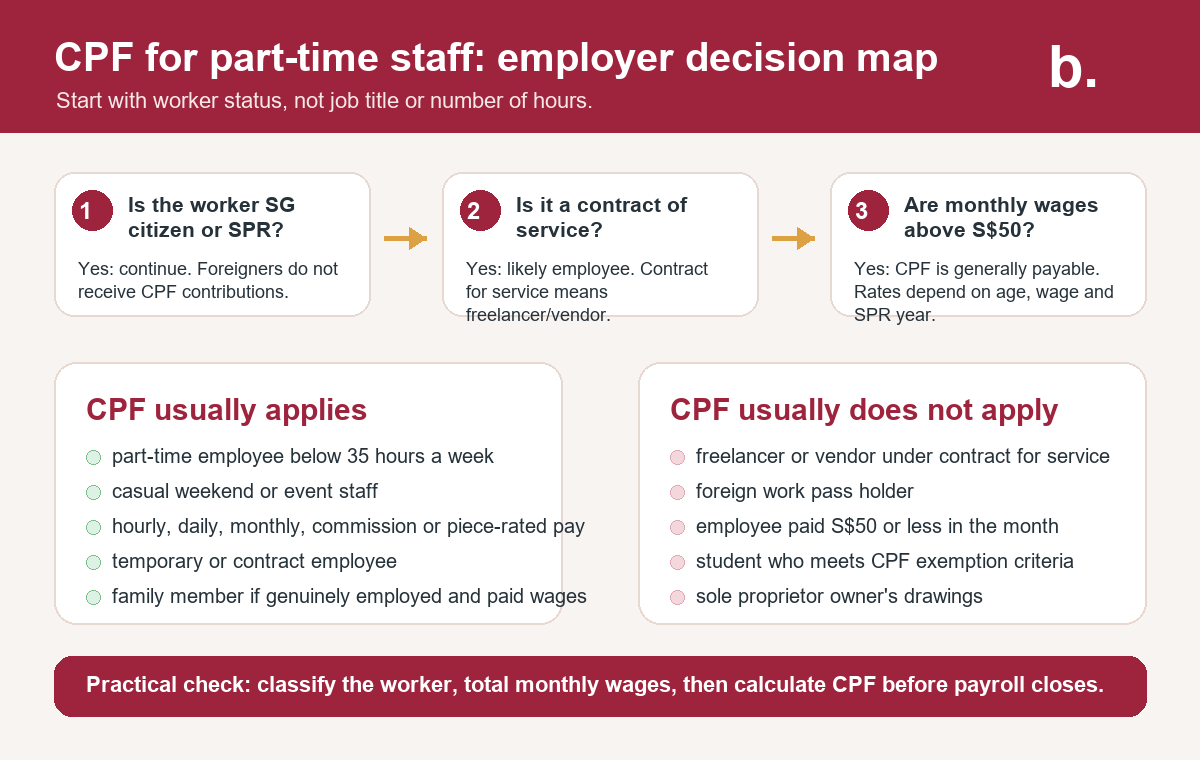
For CPF, start with three questions:
- Is the worker a Singapore Citizen or Singapore Permanent Resident?
- Is the worker your employee under a contract of service?
- Are the total wages for the month more than S$50?
If the answer is yes to all three, CPF is generally payable even if the person works only a few hours a week.
MOM defines a part-time employee as someone under a contract of service who works less than 35 hours a week. CPF Board also makes clear that employees can be full-time, part-time, temporary or contract, and can be paid hourly, daily, monthly or piece-rated.
The law behind the answer
The main law is the Central Provident Fund Act 1953. CPF Board states that under the CPF Act, an employee includes a person employed in Singapore under a contract of service. Employers have a legal obligation to pay CPF contributions correctly and promptly for their employees.
In practical terms, this means a business owner should not decide CPF based only on the worker’s title. “Helper”, “part-timer”, “casual staff”, “contract staff” and “intern” are not enough by themselves.
The real question is whether the person is an employee under a contract of service or an independent contractor under a contract for service.
Part-time CPF scenarios
Use this table as a practical starting point. It is not a substitute for legal advice, but it will help you avoid the common payroll mistakes.
Scenario | CPF position | What the owner should check |
|---|---|---|
Part-time cashier works every weekend | CPF generally payable if Singapore Citizen/SPR and monthly wages exceed S$50. | Track total wages for the month, not only hours worked. |
Ad hoc event helper for two days | CPF can still apply if the person is your employee and wages exceed S$50. | Do not assume “casual” means no CPF. |
Hourly staff with changing shifts | CPF generally payable when employee conditions are met. | Use the month’s actual wage amount for CPF calculation. |
Temporary contract employee for three months | CPF generally payable if employed under a contract of service. | The word “contract” does not automatically mean freelancer. |
Commission-based part-timer | CPF may apply because commission can be wages. | Classify the payment and check if it is Ordinary Wages or Additional Wages. |
Student working part-time during holidays | CPF generally applies if the student is a normal employee, unless a CPF student exemption applies. | Check whether the student fulfils CPF Board’s exemption criteria. |
Intern under a recognised school programme | May be exempt if CPF exemption criteria are met. | Verify the exact school/programme and keep supporting documents. |
Foreign work pass holder working part-time lawfully | No CPF for foreigners. | Check work pass legality separately. CPF is not a substitute for MOM work pass rules. |
Singapore PR in first or second year of PR status | CPF applies, but graduated SPR rates may apply unless higher rates are chosen. | Get the PR conversion date and use the correct CPF rate table. |
Family member helping in the shop and receiving wages | CPF can apply if there is a genuine employment relationship. | Do not rely on family relationship as the reason to skip CPF. |
Sole proprietor taking owner’s drawings | No employer CPF on the owner’s own drawings. | Self-employed MediSave obligations may still matter. |
Freelancer invoices for a project | No employer CPF if the person is genuinely an independent contractor. | Use a proper scope, invoice and contract for service. |
Part-time employee vs freelancer: the CPF difference
This is where many SMEs get confused.
A contract of service is an employer-employee relationship. MOM explains that it can be written, verbal, expressed or implied. It usually covers employment terms such as working hours, job scope, leave and salary.
A contract for service is different. It is where an independent contractor, self-employed person or vendor is engaged for a fee to carry out an assignment or project.
Question | Part-time employee | Freelancer / contractor |
|---|---|---|
Relationship | Employer and employee. | Client and independent contractor. |
Typical control | Business sets roster, work method, workplace and reporting. | Contractor decides how to deliver the agreed outcome. |
Payment | Wages, salary, hourly pay, overtime, commission or allowance. | Service fee based on invoice, milestone or project scope. |
CPF | Employer CPF generally applies for Singapore Citizen/SPR employees earning more than S$50 a month. | Employer CPF generally does not apply if genuinely self-employed. |
Employment Act | May be covered, depending on the worker and arrangement. | Not covered as an employee. |
Risk if misclassified | CPF underpayment, late interest, back payment and enforcement risk. | The contractor label may be challenged if the facts show employment. |
Changing the label on the invoice does not change the facts. If you control the worker like staff, roster them like staff, pay them like staff, and integrate them into normal operations, you should be careful before treating them as a freelancer.
What payments count for CPF?
CPF is computed on wages payable to employees. CPF Board gives examples of wages such as basic wage, overtime pay, bonus, allowance, commission and cash incentive.
Some payments are not wages, such as genuine reimbursements for official expenses, termination benefits that are not for services, and benefits in kind. The treatment depends on the payment, not the name you give it.
For part-time staff, this means you should total the actual pay for the month. If a part-timer earns S$12 per hour and works enough shifts to earn more than S$50 in the month, CPF may apply if the other conditions are met.
What if the part-timer earns S$50 or less?
CPF Board states that employers are required to pay CPF for Singapore Citizen and SPR employees earning total wages of more than S$50 per month.
So if an employee earns S$50 or less in that month, CPF is generally not payable for that month. But do not turn this into a planning trick.
If the worker later earns more than S$50 in another month, CPF may become payable for that month. You still need proper payroll records.
What business owners should do before payroll
A practical pre-payroll check can prevent most CPF mistakes.
- Confirm citizenship or PR status. CPF rules differ for Singapore Citizens, SPRs and foreigners.
- Confirm the relationship. Decide whether it is a contract of service or contract for service based on the actual working arrangement.
- Get the correct personal details. Keep name, NRIC/FIN where applicable, date of birth and PR conversion date if relevant.
- Track total wages for the calendar month. Include hourly wages, overtime, allowances and commission where they are wages.
- Check special cases. Students, interns, overseas postings and unusual arrangements may need extra verification.
- Use the calculator before payment. Estimate employer and employee CPF before finalising payslips.
- Submit CPF on time. Employers need a CPF Submission Number (CSN) to submit CPF contributions.
You can estimate the contribution using the SBO CPF Contribution Calculator. For official submission and exact compliance, use CPF Board’s employer services and current CPF rate tables.
Common bad reasons for skipping CPF
These are the explanations that often create trouble later:
- “They only work on weekends.”
- “They are paid hourly, so they are not real staff.”
- “They asked to receive cash without CPF.”
- “They are family, so CPF does not matter.”
- “We call them a freelancer, but they follow our roster.”
- “They are on probation.”
- “The employment is temporary.”
None of these reasons automatically removes CPF if the legal conditions are met.
What happens if CPF is not paid correctly?
CPF Board treats non-compliance seriously. Employers may have to pay outstanding contributions and late payment interest. CPF Board can also audit employers, require documents and take enforcement action.
The due date for CPF contributions is the last day of the calendar month, and CPF Board states that enforcement action may be taken when employers fail to pay by the 14th of the following month, or the next working day if that day falls on a weekend or public holiday.
For a small business, the bigger problem is not only the penalty. It is the disruption: back calculations, employee complaints, payroll corrections, records requests and management time lost.
Simple decision framework
When you are unsure, think in this order:
- Worker status first. Employee or independent contractor?
- Residency second. Singapore Citizen, SPR or foreigner?
- Monthly wage third. More than S$50 in total wages for the month?
- Rate calculation fourth. Age, wage band and SPR year can change the contribution amount.
- Documentation always. Keep contracts, timesheets, invoices, payslips and payroll calculations.
If the facts point to employment, budget CPF as part of the labour cost from the start. It is safer to price the job correctly than to discover later that the “cheap part-timer” was not cheap after CPF back payments.
Bottom line
Yes, a business owner usually needs to pay CPF for part-time staff if they are Singapore Citizen or SPR employees and earn more than S$50 in the month.
The number of hours matters for employment classification, but it is not the main CPF escape route. A part-timer can still be an employee. A temporary worker can still be an employee. A casual worker can still be an employee.
The safest habit is simple: classify the worker properly, keep payroll records, calculate CPF before paying wages, and use the CPF Contribution Calculator to estimate the employer and employee shares before submission.
Frequently Asked Questions
Do I need to pay CPF for part-time staff in Singapore?
Usually yes, if the part-time staff member is your employee, is a Singapore Citizen or Singapore Permanent Resident, and earns more than S$50 in total wages for the month. The fact that the person works part-time does not by itself remove CPF obligations.
Do I need to pay CPF for a casual worker who works only one or two days?
CPF can still apply if the casual worker is an employee under a contract of service, is a Singapore Citizen or SPR, and earns more than S$50 in the month. Check the actual working arrangement, not only the short duration.
Do I need to pay CPF for freelancers?
Generally no, if the person is genuinely an independent contractor under a contract for service. But if the facts show an employer-employee relationship, calling the person a freelancer may not be enough.
Do I need to pay CPF for student part-timers or interns?
CPF generally applies to student part-timers who are normal employees, unless they meet CPF Board’s student exemption criteria. For interns, verify the exact programme and keep supporting documents.
Where can I calculate CPF for a part-time employee?
You can use the SBO CPF Contribution Calculator to estimate CPF based on wage, age, citizenship or SPR status. For official submission, use CPF Board’s employer services and current CPF rate tables.
Explore More Content
Table of Content